
Nervous system · The science
More than “just relaxing”: the science of regulating your nervous system

For a long time, working with the nervous system has been brushed off as “soft” therapy, or as a wellness trend. I understand why. A lot of what you see online is vague, and some of it overpromises.
But the research picture has changed. Studies using brain imaging, stress hormone measures and heart rate variability (HRV) show that how your nervous system responds to stress is something physical and measurable. It isn’t a mindset, and it isn’t a matter of willpower.
Here’s what that means for your body, and why it might explain more than you’d expect – whether you’re living with a long-term condition, running on empty from looking after everyone else, or moving through a big change in your life.
Your body talks to your brain more than you might think
The vagus nerve is one of the main communication lines between your body and your brain. Around 80% of its fibres are afferent – they carry information up from your body to your brain, not down.
So your brain isn’t only telling your body how to feel. Your heart, lungs and gut are constantly sending information back up to your brainstem, and your brain is using it to decide whether you’re safe.
This background safety check is called neuroception. It runs all the time, without asking your permission, scanning three things: your surroundings, the people around you, and what’s happening inside your body.

When the stress response gets stuck
After a long illness or injury, years of caring for others, a big life change, or months of ongoing stress, the nervous system can start to treat “on alert” as normal. Your baseline shifts.
It doesn’t always take one big event. Lots of smaller loads, carried for a long time, add up too.
Your window of regulation – the range of stress your body can handle before it tips into fight-or-flight or shutdown – gets narrower. More time in a stress state means more stress hormones, and less energy going to things like digestion, sleep, tissue repair and immune function.
From the inside, that can look like:
- lying awake even when you’re exhausted, or waking at 3am with your mind racing
- tension in your neck, shoulders or jaw that keeps coming back, even after a massage
- brain fog, headaches or a gut that seems to have a mind of its own
- feeling wired and tired at the same time
- snapping at people you love, then feeling guilty about it
- noise, crowds or busy days wiping you out more than they used to
If you’ve been told it’s “just stress” and sent home, you may have left feeling unheard. These are real, physical responses. None of this is a personal failing. It’s your nervous system doing its job of protecting you, just a little too well.
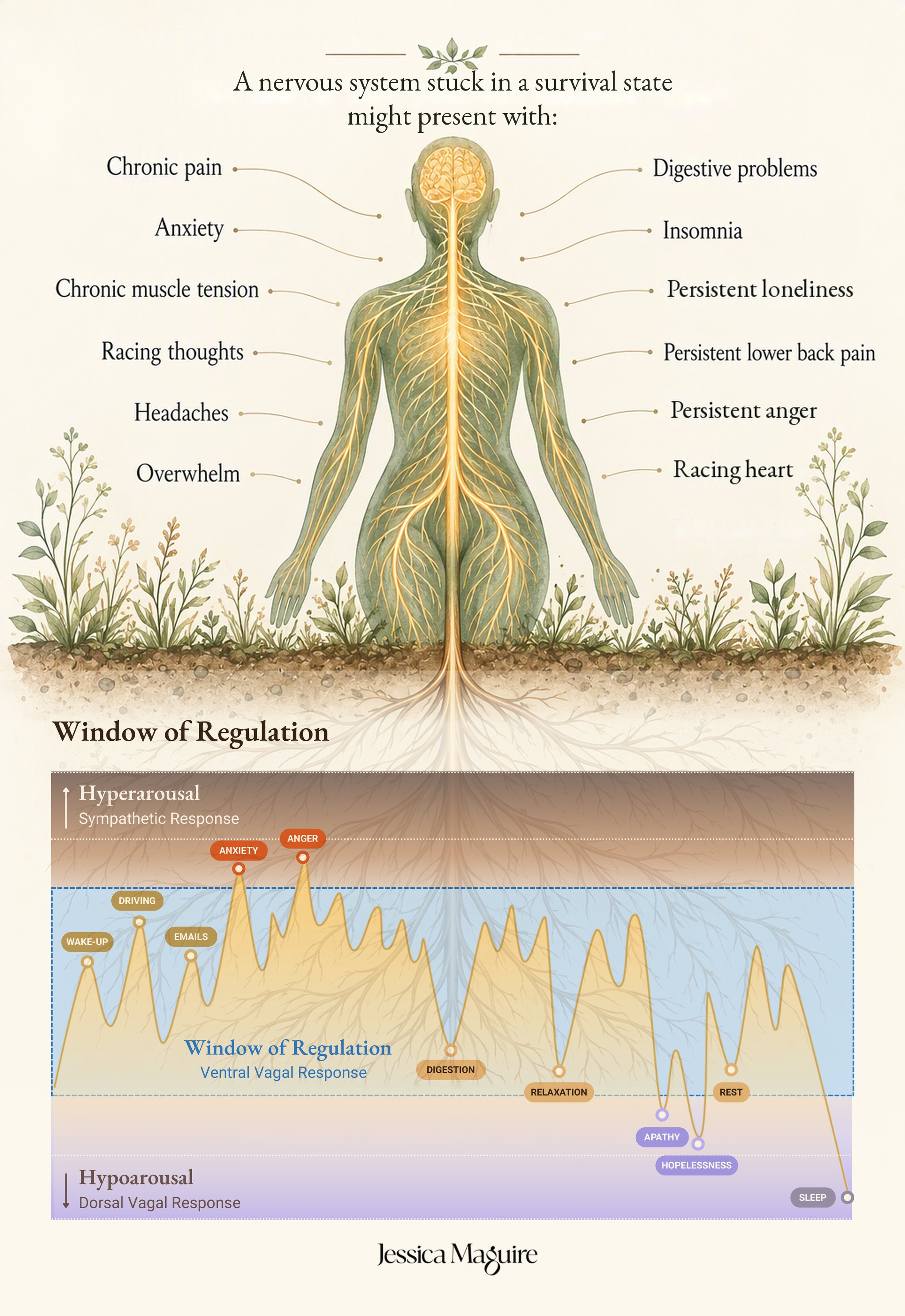
Window of Regulation graph: Jessica Maguire, Nervous System School. Used with permission.
Bottom-up, not mind over matter
Helping your nervous system come back to balance isn’t about thinking positive, or taking one deep breath and hoping for the best.
It’s a bottom-up approach. We use gentle, body-based inputs – breath, where your eyes rest, small movements, sensations of support – to send signals of safety from your body up to your brain.
With repetition, your nervous system can learn from those signals. That’s neuroplasticity: the brain and nervous system adapting to new experiences. Over time, the aim is a system that can handle more physical and emotional load before it reaches for the alarm.
The research in this area is growing, and some parts are stronger than others. I’ll always be straight with you about what we know and what we’re still learning.
What this can look like in real life
A stuck stress response doesn’t look the same for everyone. Here are a few of the ways I see it.

When you’re the one holding everything together
Maybe you’re a carer, a parent, or you work in a helping profession. You’re good at noticing what everyone else needs. Saying no feels hard, so you say yes, and the resentment builds quietly underneath.
Your nervous system may have learnt that staying on alert is what keeps things running. Switching off can feel impossible, or even unsafe. That’s not a flaw in you. It’s a pattern your body has practised, and patterns can change.

When your body and life are changing
Perimenopause, becoming a mother, grief and loss, a career or relationship change – these chapters ask a lot of your nervous system. Hormonal shifts can affect sleep, body temperature, mood and how reactive your stress response is. Big life changes can leave you feeling like you’re not quite yourself.
You don’t need to be in crisis to deserve support. Sometimes it’s simply about having more room to move through a big season without running on empty.

When the world feels loud
If you’re sensitive or neurodivergent, everyday life can bring a lot more input – noise, light, textures, social demands, and the effort of masking to fit in. By the end of the day, there may be nothing left in the tank.
This work isn’t about changing who you are. It’s about understanding your nervous system and giving it more ways to recover.

When you live with a long-term condition
With POTS, chronic pain, ME/CFS, fibromyalgia and other long-term conditions, your body can feel stuck in survival mode. This isn’t “just anxiety”, and it isn’t in your head.
With POTS, standing up can make blood pool in the lower body. Your nervous system reads that as a threat and presses hard on the accelerator – adrenaline, a racing heart, shakiness, fog – even though all you’re doing is standing in your kitchen.
With persistent pain, your nervous system – your brain and spinal cord together – can become more protective over time, turning up the volume on signals from your body. The pain is real. The system around it has become more sensitive.
With fatigue conditions, the work is gentle and slow. There’s no pushing through.
Different stories, but a common thread: a nervous system that has spent a long time protecting you, and needs help to find the foot brake again.
How finding the foot brake can help
This work doesn’t replace medical or psychological care. It sits alongside what you and your GP, psychologist or specialist are already doing.
What it adds is a focus on building capacity in your nervous system, including the parts of the vagus nerve that act like your body’s brake pedal. We work towards three things:
- Better braking. More ability to come back down after a stressful moment – a hard conversation, a busy day, a flare or a heart rate spike – so those peaks may become shorter or less intense.
- A wider window of regulation. Gradually increasing how much life your body can handle – work, family, movement, noise, effort – before it flips into fight-or-flight or crashes into exhaustion.
- Less stress-hormone overload. When your system isn’t constantly flooded, many people notice their sleep, energy, digestion and recovery start to improve, and they feel more like themselves.
Everyone’s body responds differently, and progress is rarely a straight line. That’s normal.

How this works in physio
In our sessions, I’m not going to push you past what your body can manage. We work with your nervous system on the day.
You don’t need a diagnosis, and you don’t need to tell your whole story. We start with what’s happening now and what you’d like to be different.
That means titrating – taking small, manageable steps, noticing how your body responds, and building from there. Tools might include gentle breath patterns, orienting to your space, noticing support, and very small doses of movement.
The goal is to teach your body something new: that it can be safe to recentre, safe to adapt, and safe to move again.
Try this
A 30-second orienting practice
If you’d like a small taste of what this feels like, try this now. Please do it sitting or lying down.
- Let your eyes slowly wander around the room. No need to look for anything in particular.
- Let your head turn gently with your eyes, only as far as is comfortable.
- Find one thing you like the look of – a colour, a plant, the light – and rest your eyes there for a few breaths.
- Notice what’s supporting you: the chair, the floor, the bed under you.
- Notice any small shift – a sigh, a swallow, your shoulders dropping a little.
Nothing needs to happen. If you feel dizzy or uncomfortable, stop and rest. Small and subtle is exactly the point.

If you’d like support
I work with people who are running on empty from caring for others, moving through big life changes, living with sensitive or neurodivergent nervous systems, or managing POTS, chronic pain, fatigue and other long-term conditions. Sessions are by telehealth, Australia-wide, for adults and teens 14+.
If you’d like to explore whether this approach is a good fit for you, you can book a session or email me at [email protected].
This article is general information, not individual medical advice. If your symptoms are new, changing or worrying you, please see your GP. If you have chest pain or trouble breathing, or faint and hurt yourself, seek urgent medical care.